

Dear All,
Many of us as we grow up come across various kinds of
teachers: the strict one, the warm one, the delight, the rule
abiding, the amateur, the thesaurus and what not. As a child
who always used to paint the world either black or white—I
nicknamed my first ever two teachers as Miss Sour and Miss
Sweet based on the attribute they displayed in the class (not that
I knew their real names). I was three years old, and the notion
of stepping out of the house to stay at a nursery didn’t appeal to
me at all. How they treated me led to those nicknames.
Categorising and name-calling became my forte as I grew
up and reached middle school. I always had this story running
in my mind about two sisters my Grandfather used to narrate:
Vidya (Knowledge) and Siksha (Education). Vidya was the
superior one—more learned, benevolent, and treasured by
all—whereas Siksha was highly erudite, street-smart, and sly.
Once, on an early morning, they went to a pond together for a
bath. Jealous, Siksha tried to seize the opportunity, took Vidya’s
clothes and hurried to the shore, dressed as her sister. When
Vidya realised this, she shunned Siksha’s clothes, and remained
naked instead. Sad and embarrassed, she left her homeland
and never came across anybody. Since then, people have been
mixing the true identities of the sisters, believing Siksha to be
Vidya.
As I passed grades after grades, I realised many of my
teachers were like Siksha, strictly professional in their work,
very smart donning a highly calculated and proportionate smile.
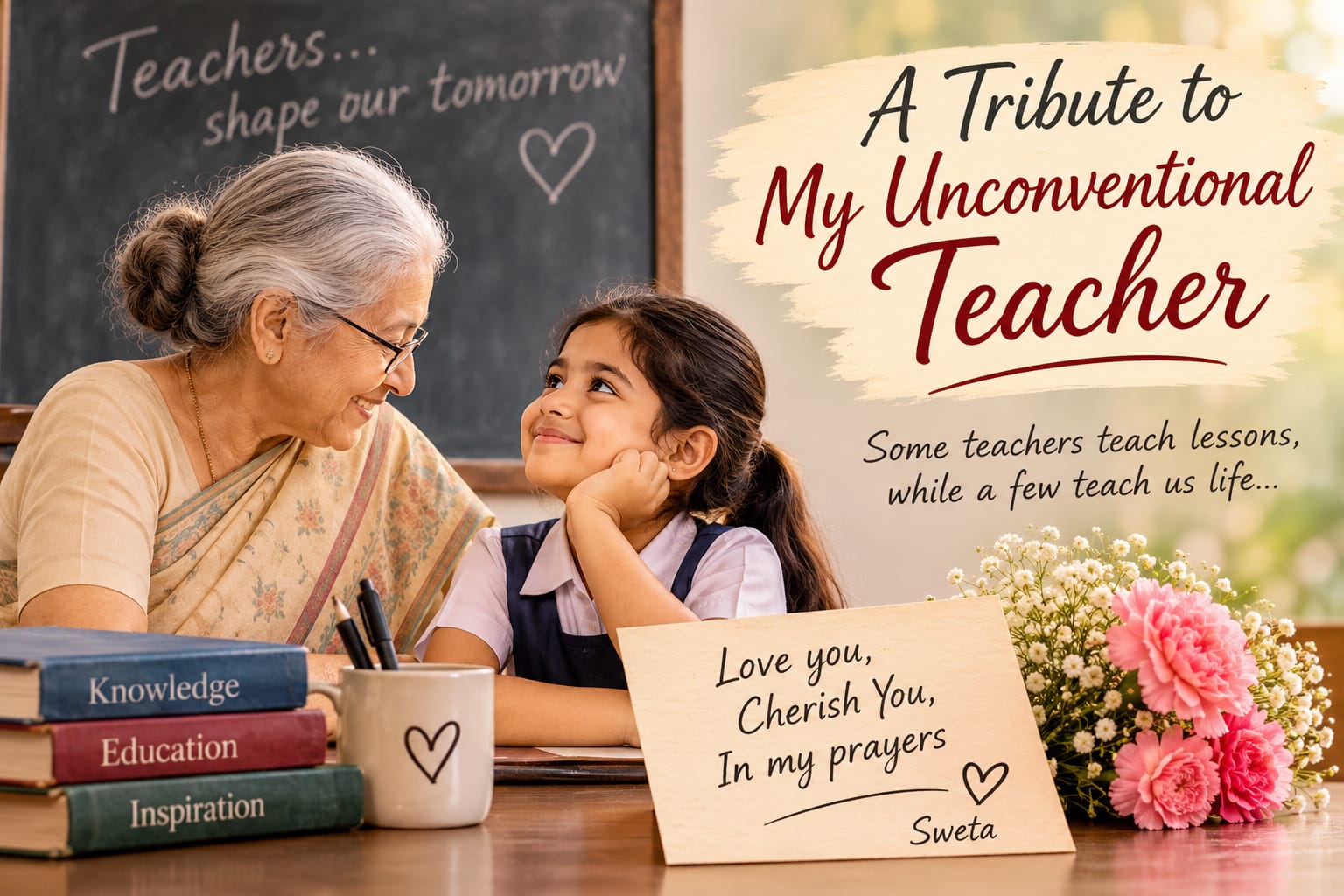
Until I met Mrs. Geeta Ghoshal, she was a new teacher in our
school who was a retired English Professor. By the looks of her,
she seemed beyond 65 and had thin grey hair which she tied as
a bun. She always used to wear light coloured cotton sarees and
carried a small brown purse.
She had a different way of teaching and never revised her
syllabus once the course got over. Instead, she used to sing her
favourite Bengali and English songs and made us play games.
Best, was the time when she used to talk about her travels. I
remember how she garnered undivided attention from every
kid in the class as she discussed her Moscow Trip and how
she couldn’t get normal fizz-free water for three hours until
she boarded her plane. One of my classmates believed by fizz
she meant some exotic drink! She wasn’t pleased hearing it and
replied that her son-in-law would never offer her any such drink.
A big surprise happened after the exams where she had
graded the students quite differently than usual. The regular
toppers were pushed back and I, an average kid, was the highest
scorer. Even I was in shock as were other “meritorious” kids.
The reason she liked my answers was because she found them
straight and simple. Neither fancy nor ornamented. Short and
crisp making it a delight to read. This was the first time I realised
that quality mattered over quantity.
Her remarks were highly encouraging more so than all the
“can do better” and “has potential to perform” I had received in
my report cards. Although many parents and students rebelled
against her grading scheme and a substitute teacher was finally
deployed to reevaluate the papers. It is not a surprise, why and
how the capitalist nature of institutions creeps in. Give and take
policy is something people find easier to conform to than to try
and understand the unconventional.
It is strange that a forgetful person like me has such a
vivid memory of a teacher who taught me two decades ago.
From her appearance to her actions—nothing faded over the
years. I never told her how I felt about her, never gave her any
flower or bouquet like any other teacher’s pet. No letters. No
greeting cards. Not even mentioning her to my best friends.
With this letter I want to thank my unconventional teacher. It is
unfortunate that she left this world when I reached high school.
She was a treasure and I genuinely felt bad about her demise—a
girl who was highly insensitive as a child.
She didn’t go beyond her capacity to praise me; it was just
what was needed by a student from a teacher. A realisation
about my ever-evolving skills that I was no less than anyone and
the first one to say, ‘Hi little girl, you write quite well.’
Love you, Cherish You,
In my prayers
Sweta