
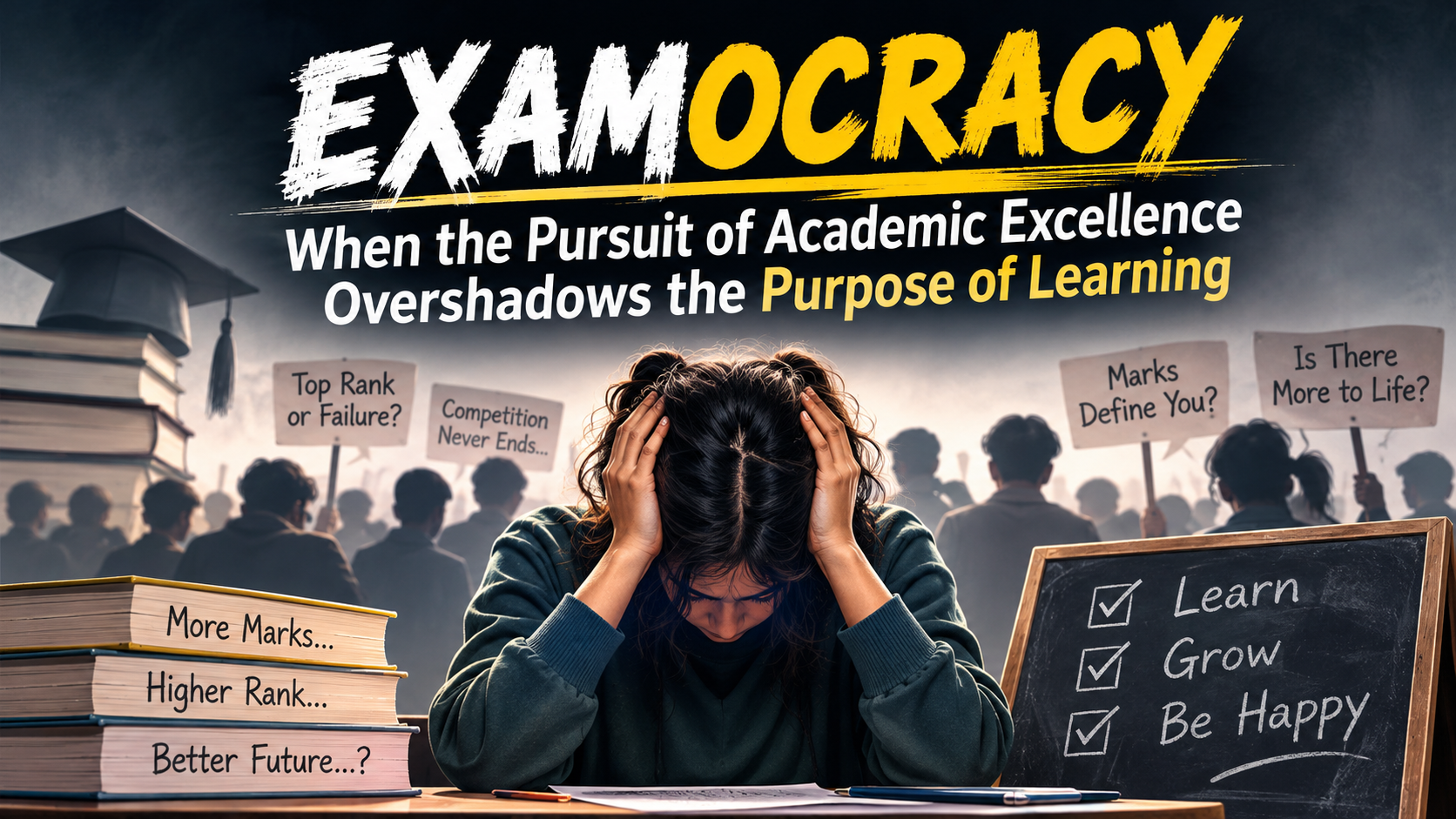

When the Pursuit of Academic Excellence Overshadows the Purpose of Learning
Is it really just an examination, or are we unknowingly fighting a much bigger battle—a silent war between ourselves and society?
From childhood to adulthood, everyone carries their own story of examinations. Different habits, preparations, and struggles, yet somehow, we all find ourselves in the same race. We often hear that everyone fears exams, but rarely does anyone ask why. I don’t think marks are the only reason. Beyond question papers and results, there exists a silent competition—one that nobody openly discusses, yet almost everyone experiences. We constantly measure our worth against someone else’s achievements, sometimes without realising when this habit began.
In Asian countries, particularly in India and Bangladesh, I have often noticed how rarely students seem genuinely at ease during examination periods. Anxiety rises, and the fear of losing one’s position becomes overwhelming. We describe competition as healthy because it motivates us to perform better. However, not every form of competition contributes to personal growth. Examinations should be an opportunity to demonstrate what we have learned, not a battle we must win. Yet, we are encouraged to secure the first or second position, while accepting anything less can feel like a failure. Society teaches us to measure our progress against others, overlooking the fact that every student has a different pace, journey, and set of circumstances.
Imagine scoring 90 marks and still feeling disappointed—not because you performed poorly, but because your friend scored 95. Suddenly, your achievement seems less significant simply because someone else achieved a little more. We struggle to appreciate our own accomplishments while remaining conscious of someone else’s success. Another person’s achievement does not diminish our efforts, yet we often behave as though it does. Our parents reassure us with familiar words: “One day, you will get the results you desire. Just keep trying.” But we are rarely taught how to become better versions of ourselves rather than constantly striving to outperform others. We need to learn to accept failure, recognise gradual improvement, and remain confident even when we do not achieve the position we hoped for. A single examination score should never define our abilities.
The problem does not end with comparison. There is another uncomfortable reality that deserves attention: cheating during examinations. Sometimes, students who put little effort into preparation manage to secure unexpectedly high marks through unfair means. Meanwhile, those who prepare sincerely may receive less recognition. This raises a serious question of fairness. What is the value of an academic position when the process of achieving it is compromised? When someone questions these practices, they may hear, “Why couldn’t you do the same?” But dishonesty should never become acceptable simply because someone else has benefited from it. Sincere effort should not lose its value in a system where unfair advantages go unquestioned.
This brings me to something I genuinely want to highlight: examination justice. We frequently speak about gender justice, social justice, and equal opportunities. Examination justice deserves attention too. I urge professors, teachers, and educational institutions to uphold fairness throughout the examination process. Every student’s work deserves an honest evaluation, and every mark should reflect genuine merit. Behind every answer sheet is a student carrying personal struggles, expectations, insecurities, and aspirations. Fairness does not mean giving everyone identical marks; it means ensuring that every student has an equal opportunity to demonstrate their knowledge without unfair advantages or discrimination.
Beyond fairness, we also need to reconsider what examinations are meant to teach us. Education should not become a lifelong competition in which students measure their worth against one another. It should be a journey of discovering individual abilities, recognising weaknesses, learning from mistakes, and growing at one’s own pace. There is far more to student life than marks and certificates. Build meaningful connections with your campus, professors, and the people around you. Explore, make memories, and appreciate the experiences that make these years significant. Do not allow examination pressure to overshadow the joy of being a student. Long after graduation, your friendships, experiences, and memories may mean far more than the marks on a certificate.
With this in mind, I would like to offer a suggestion to future students: learn to keep certain aspects of your academic journey private. You do not always have to announce your results, whether they reflect success or disappointment. Protect your peace from unnecessary comparisons and external opinions. Instead of constantly measuring yourself against others, evaluate your own efforts. Recognise how far you have come. Personal growth does not require public recognition to hold value.
Perhaps we can create a different environment for the next generation. We can teach children to approach examinations with confidence rather than associate them with constant anxiety. Let every examination be an experience, every result a lesson, and every setback an opportunity for self-reflection.
You do not have to be the best every time. Sometimes, the greatest achievement is recognising your own progress, even when nobody else notices. After all, an examination should assess what you have learned, not determine how much you are worth.