
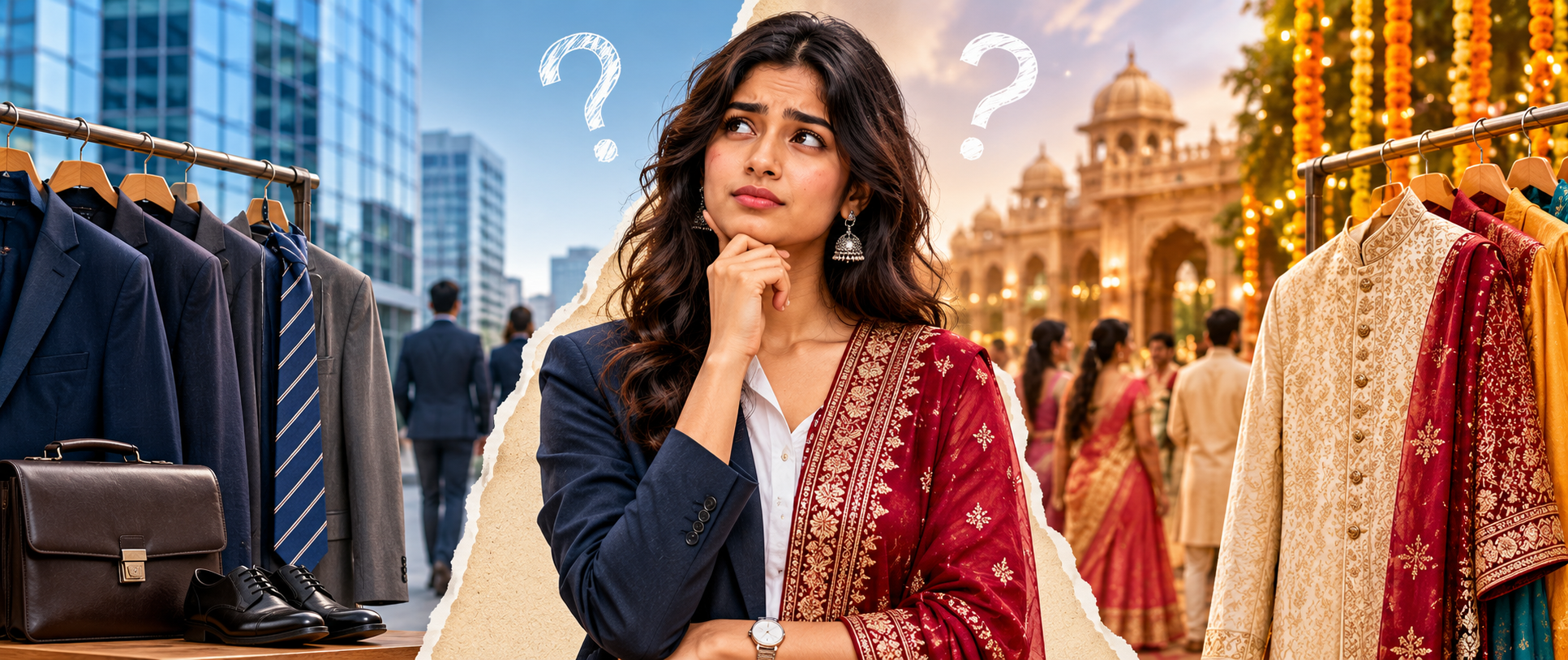

Walk into any Indian office on a Monday morning and look around: blazers, ties, and polished leather shoes, all in a country where summer temperatures touch 45°C. Now look at the same people at a cousin’s wedding: silk kurtas, bandhgalas, and sarees. Suddenly, they look like themselves again.
So here is the question worth asking: why does “formal” mean Western, while “Indian” means “festive”?
How the Suit Walked In
The story starts with colonial rule. The British did not just bring administration; they brought a dress code. To work in a government office, be taken seriously in court, or be seen as “modern” and “civilised”, you had to dress like your rulers. Trousers and coats became symbols of education and status. Indian clothing, however elegant, was slowly labelled “traditional”, a polite word for “not for serious business”.
There was resistance, of course. Gandhi’s khadi turned simple homespun cloth into a political statement. After independence, Nehru made the achkan and bandhgala marks of statesmanship, while the Jodhpuri suit proved that Indian tailoring could be every bit as sharp as Savile Row.
But then came 1991. Liberalisation opened the economy, multinational offices filled our cities, and the global corporate uniform came with them. Success started to look like a navy blazer. Slowly, our wardrobes split in two: Western for the week, Indian for the weekend.
The Truth: It Isn’t “Necessary”
Let’s be straight. No law of nature says an Indian professional must wear a suit. It is a habit we inherited and never questioned. It survives because of three things: global business conventions (when you meet clients abroad, you dress alike), the fear of looking “less professional”, and plain familiarity.
A suit is not better. It is just the default.
In fact, our own clothes are made for our own conditions. Cotton, linen, and khadi breathe. A well-cut kurta with a Nehru jacket is formal, comfortable, and unmistakably ours. The problem was never the clothing. It was our confidence.
Why Only Festivals?
Because we let ourselves believe that heritage belongs to celebration, not to work. Diwali, Eid, and weddings became the only occasions when we “allowed” ourselves to look Indian.
Meanwhile, the sherwani, the saree, and the dhoti quietly moved from daily life into the costume cupboard.
And the irony deepens. The West now borrows what we sidelined. Foreign celebrities walk red carpets in sherwanis and sarees, brands launch “kurta-inspired” collections, and colleagues abroad turn up in kurtas for Diwali parties. Yet, they treat them as occasion wear, too.
When they wear it, it is exotic. When we wear it to work, we worry it looks underdressed. Same fabric, different respect.
Reclaiming the Wardrobe
This is not an argument against suits. Wear one if you love it or if the boardroom demands it. The point is choice.
Japan wears the kimono at ceremonies, but also embraces modern versions in daily life. Many African professionals wear structured prints to the office. Nobody calls them less formal.
India can do the same. Handloom blazers, linen bandhgalas, and cotton sarees on a Monday, not just on Diwali. Every time we wear them to work, we tell the next generation that heritage is not a costume. It is a living, working wardrobe.
So, the next time you reach for that tie in a humid July, ask yourself one honest question: am I dressing for the job, or for someone else’s idea of the job?
Our clothes carry centuries of craft. They deserve more than twelve festive days a year.