
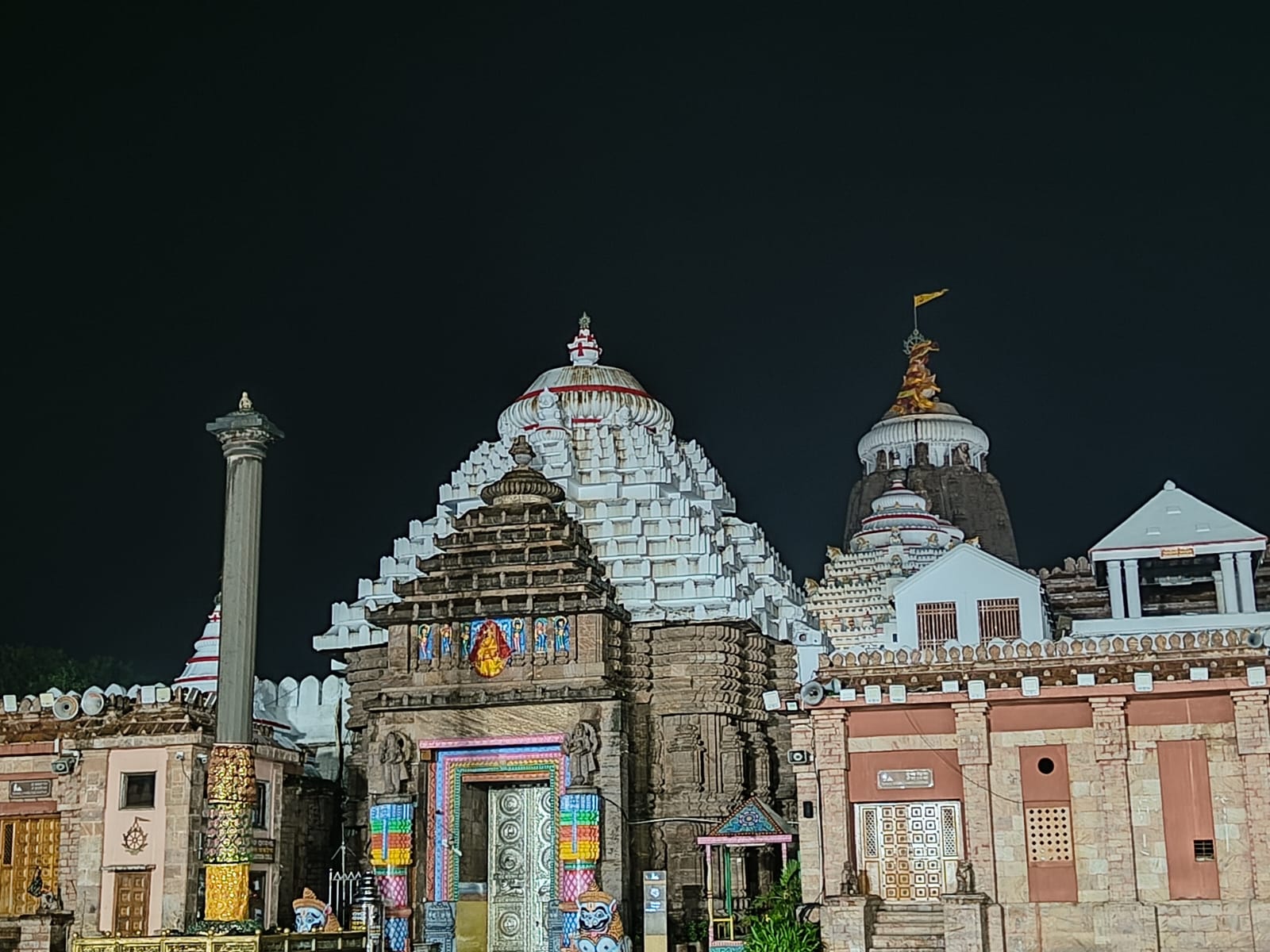

You do not visit Lord Jagannath. You get summoned. Somehow, every person who has been to Puri knows exactly what that means.
My friends and I tried to visit Puri three times in one year during our college days. It was never really about the will; every time we planned it, the travel itself worked against us. The first time, the car fell through at the last minute and getting hold of another way to travel just didn’t work out; so the trip stalled before it properly began. Second time, we actually made it onto the road, until one of our rear tires went flat halfway; it took us 30–40 minutes just to find a mechanic and another 1hour before we were moving again. By the time we reached, we were so time-bound that we could only see the temple from the outside. Third time, we set out on a day so relentlessly sunny that the heat got to all of us, and somewhere along the way, one friend said what we were all quietly thinking: maybe it isn’t our time to see him yet; maybe He doesn’t want us right now. So, we turned back.
The fourth time wasn’t planned at all. It was one of those random days when one of us just said, Let’s go to Puri and if we’re going, let’s actually try to visit the temple this time. No itinerary, no checklist, just that one shared decision. We reached Puri in two hours. The queue was long. We walked straight to the sanctum. We came back with an experience we still can’t properly explain
We are convinced that the first three times simply weren’t our time. The fourth time, Lord Jagannath said: Now. As one of us put it afterwards: it is not always you who decides when to see him. It is always him.
The Belief that finds you whether you’re looking or not
There’s an old saying among the people of Puri and among devotees who have made this journey from every corner of the country for centuries: you don’t go to Jagannath Puri, Jagannath Puri comes to you. The Lord himself decides when your eyes are ready to see him. When your heart is in the right place. When whatever you’re carrying into that sanctum is something he’s willing to receive.
You can plan the trip down to the last detail. Book the bus, car, or flight; find accommodation on Marine Drive; check the darshan timings; and set three alarms. However, something will still shift–a delay, a crowd, a closed gate, a missed turn–and you’ll find yourself standing outside instead of inside, wondering why.
Or you will go on a whim, barely prepared, and the temple will be quiet, the priests unhurried, and you will stand before those enormous eyes of the deity and feel, for reasons you cannot entirely account for, that you were expected.
“People do not visit Jagannath. Jagannath invites people. The difference sounds small. It changes everything about how you travel to Puri.”
The darshan that cannot be forced
Inside the Jagannath Temple, non-Hindus cannot enter. A rule that has its own long and complicated history and one on which the temple holds firm. However, even for those who enter, what they experience inside is something that resists description every time someone tries.
The idol of Lord Jagannath with Lord Balabhadra and Devi Subhadra beside him is not what you expect. He is not the graceful sculpted deity of Khajuraho or the calm/peaceful marble of a Jain temple. He is abstract, almost unfinished-looking, with wide cylindrical eyes and arms that end without hands. Yet, people weep in front of him. Strangers. Grown men. People who came as skeptics and walked out quiet in a way they’d never been before.
There is a theory, not theological, just human, that the Lord’s unfinished form is deliberate. He left himself incomplete so that every devotee could project onto him what they needed him to be. A father. A friend. An anchor. Someone who, for the first time in a long time, is just glad you showed up.
What the devout say:
“Jagannath mandir mein darshan tabhi hota hai jab Prabhu bulate hain.” — Darshan at the Jagannath temple happens only when the Lord calls you. Not when you decide. Not when you plan. When he decides you are ready to receive what he has to give.”
The beach at the end of the day
After the temple, most people walk to the sea. It is only a few minutes away, and the contrast is startling, from the ancient, incense-heavy air of the sanctum to the open, salt-laden expanse of the Bay of Bengal. The beach at Puri is not the prettiest beach in Odisha. Chilika is quieter. Konark’s shoreline is more dramatic. But Puri beach has something that others don’t: it has the feeling of arrival. Of having come somewhere and been received.
People sit at the water’s edge without speaking. Some close their eyes. Some cry quietly and let the wind take them.
I believe this is what Puri does to people. Not just the temple, not just darshan. The whole day, the slow walk, the narrow lanes, the deity who looked at you or didn’t, the sea that received whatever was left over. It provides something that you did not know you needed.
You’ll know when it’s your turn
If you have been holding off going to Puri, waiting for everything to align, for the timing to be perfect, or for there to be nothing in your schedule, knowing that you will always do it “next month,” then I will not ask you to go. That is not how this works.
What I can tell you is this: the call will not come loudly; it will not be a big sign or an ideal time, but a quiet morning when you get up and know in your heart what must be done, and you’ll go, unprepared and uncertain, and something will open that you did not know had closed.
This is not a superstition. This is what happens when a place has been receiving people’s deepest selves for over a thousand years. It becomes good at knowing when you are ready, even when you do not.
Lord Jagannath has been watching the sea from that sanctum since before this city had a name. He’s not in a rush. He’ll wait for you.
And when He’s ready, He’ll call.